
AI is reshaping investment banking by automating manual tasks, speeding up processes, and improving decision-making. Here's what you need to know:
- AI's impact: Automates up to 60% of repetitive tasks, reduces client response times to seconds, and boosts productivity by 27%-35%.
- Key areas transformed:
- Equity Research: Cuts information retrieval times by 75%.
- Deal Execution: Reduces pitchbook creation from weeks to hours.
- Risk Management: Achieves 98% fraud detection rates.
- Client Services: Delivers personalized advice and faster insights.
- Real-world examples:
- JPMorgan Chase invested $2B in AI, generating $1.5-$2B annually.
- Morgan Stanley's AI tools improved document retrieval efficiency from 20% to 80%.
- AI tools: Platforms like Calypso and AskResearchGPT streamline workflows, enabling analysts to focus on strategy and client relationships.
AI is helping banks handle massive data volumes, improve client interactions, and execute deals faster, making it a game-changer for the industry.
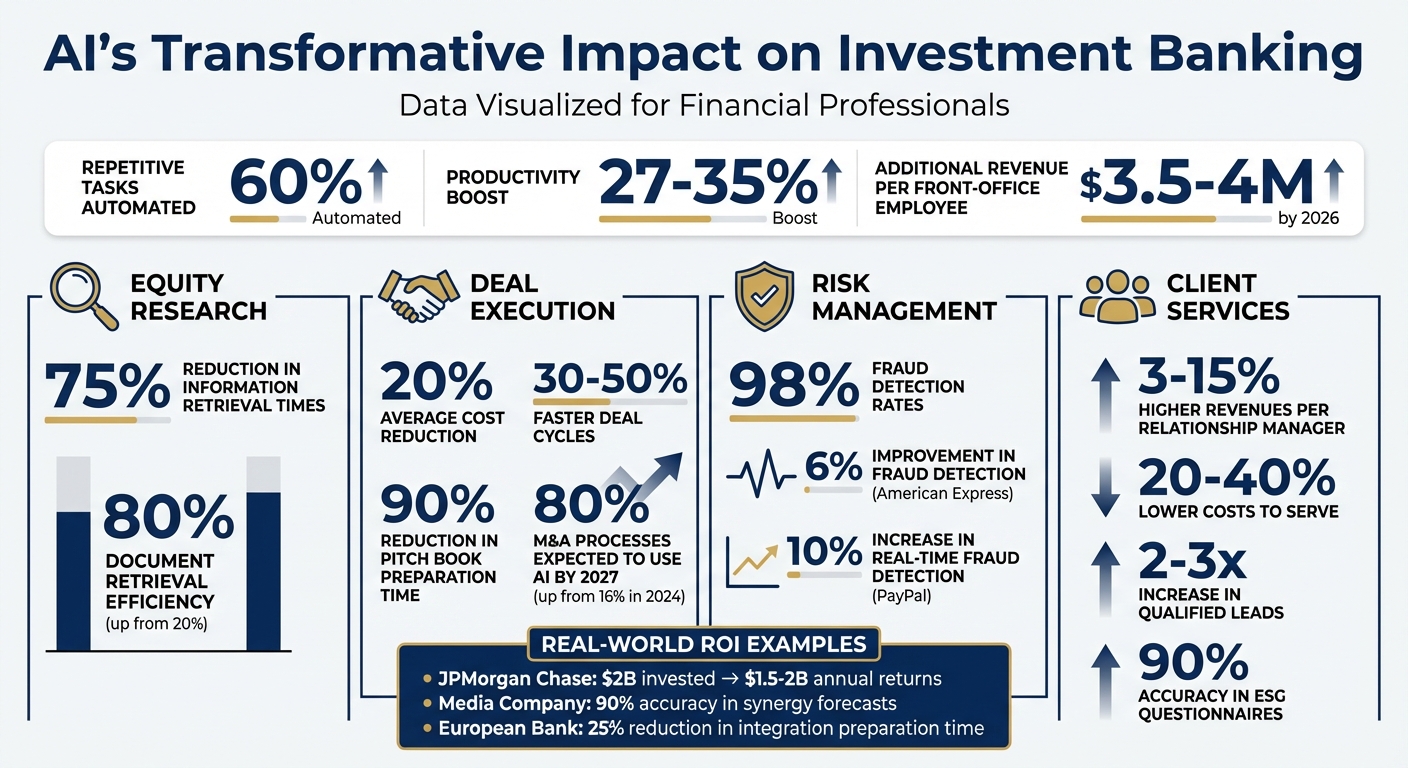
AI Impact on Investment Banking: Key Statistics and Productivity Gains
AI in Investment Banking: What Works, What Doesn’t, and How to Use It Today
sbb-itb-02b1c6d
AI in Equity Research and Analysis
Equity research has always been a race against time. Analysts juggle regulatory filings, earnings transcripts, news feeds, and market data - all while the market continues to move. Traditionally, this meant long hours poring over documents, building spreadsheets, and cross-referencing data. But AI is flipping the script, automating the grunt work so analysts can focus on strategy and client relationships.
With Natural Language Processing (NLP), AI can rapidly cross-reference market data, regulatory filings, and research reports. Peer set identification - sorting by sector, size, geography, and growth profile - becomes a breeze, cutting out days of manual effort. AI also extracts key financial metrics like revenue, EBITDA, and free cash flow conversion, calculating valuation multiples (e.g., EV/EBITDA, P/E) with a full audit trail. It even handles tricky adjustments for things like pensions and leases to ensure the data is accurate. These advancements are reshaping equity research with tools tailored to the needs of analysts.
For example, in October 2024, Morgan Stanley introduced AskResearchGPT, a generative AI assistant that allows staff to instantly search and summarize insights from over 70,000 proprietary reports. Similarly, Deutsche Bank tested a tool in early 2025 that generated a 9,000-word report with 22 sources in just eight minutes.
"AI represents a radical redefinition of decision-making across the banking value chain, from back-office calculations to trading floor strategies." - AI21 Knowledge Hub
This shift lets bankers move beyond repetitive tasks to focus on high-value activities like negotiation, strategic advisory, and client management. In fact, nearly 80% of companies using generative AI in M&A processes report reduced manual workloads, and over half have seen faster deal timelines. Calypso is leveraging these AI capabilities to streamline equity research and deliver actionable insights.
Calypso's AI-Powered Equity Analysis Tools
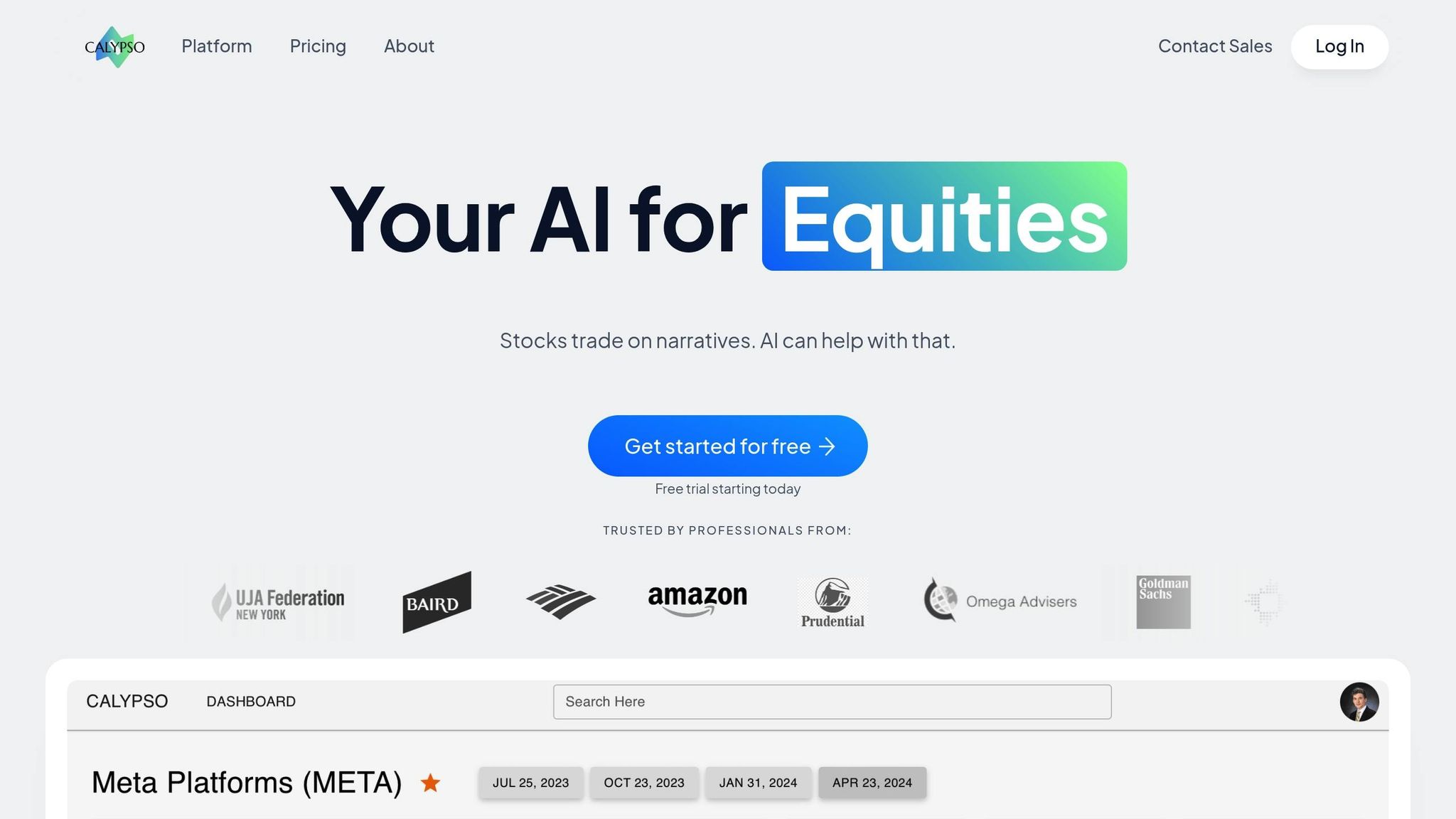
Calypso offers tools specifically designed for investment banking professionals who need quick, actionable insights without the manual grind. Powered by GPT-4 class models fine-tuned for finance, the platform enables faster stock evaluations and uncovers patterns that would take hours to identify manually.
- AI Opinions: This feature extracts key debates - bull versus bear - on specific stocks and tracks personal investment theses, helping analysts avoid "thesis creep."
- AI Chats: Analysts can skip lengthy webcasts by asking targeted questions, like whether management mentioned a competitor or product, and receive instant answers.
- AI Profiles: These summaries simplify complex business models, offering quick reference points before client meetings.
Transcript Search and Personalized Dashboards
Calypso also tackles time-consuming tasks like transcript analysis and data monitoring with smart, user-friendly tools.
Earnings call transcripts can be overwhelming, especially for analysts covering multiple stocks. A single call might last an hour, creating a daunting backlog. Calypso’s transcript search uses natural language queries to pinpoint specific mentions - like "pricing pressure" - and delivers precise answers with timestamps. No need to sift through the entire call.
The personalized dashboards keep analysts on top of their coverage while screening the broader market. By consolidating earnings calls, conferences, and meetings into one view, the risk of missing critical information is minimized. These dashboards also unify financials, valuation metrics, news, and alternative data into a single interface, offering real-time updates and tracking sentiment changes.
| Feature | Traditional Workflow | AI-Powered Workflow |
|---|---|---|
| Data Retrieval | Manual navigation across platforms | Instant access via natural language queries |
| Transcript Analysis | Listening to full 40–60 minute calls | AI-generated summaries with keyword extraction |
| Thesis Tracking | Manual journaling and static models | AI feedback on narratives and debates |
| Market Screening | Limited manual watchlists | Automated trend discovery and broad screening |
With these tools, analysts can shift their focus from data collection to deeper interpretation and strategy.
Earnings Previews and Financial Insights
During earnings season, speed and precision are critical. Calypso delivers concise earnings previews that combine analyst expectations, historical performance, and market sentiment. This helps professionals prepare for calls by highlighting key metrics and questions.
The platform’s Financial Insights go beyond raw numbers. It contextualizes data within industry trends and peer performance, automatically pulling metrics like revenue growth, margin expansion, and cash flow generation. By comparing these against historical patterns and benchmarks, analysts can quickly spot anomalies that deserve further attention.
AI-driven automation can handle up to 95% of routine tasks, such as drafting prospectuses, freeing up analysts for more nuanced work like client communication. It also processes earnings announcements and filings in real time, detecting subtle shifts in tone or capital allocation that manual reviews might miss.
"AI is not a substitute for bankers, it's a tremendous multiplier." - Anant Bengani, Chartered Accountant and Finance Educator
Calypso offers two pricing tiers: the Basic plan at $10/month, perfect for individual analysts or small teams, includes key financial data, news, and 20 daily AI Opinions and Chats. The Professional plan at $399/month scales up to 400 daily AI Opinions and Chats with live support, catering to larger teams needing deeper integration. Both plans streamline equity research, helping analysts deliver insights faster and more effectively than ever before.
AI Applications in Deal-Making Workflows
Deal execution has always been a high-pressure game for bankers. From modeling synergies and analyzing comparables to drafting pitch books, the workload is intense. Add client queries into the mix, and it's clear why deal-making is often synonymous with late nights and endless spreadsheets. But AI is flipping that script, taking over the heavy lifting so dealmakers can focus on strategy and negotiation instead of manual tasks.
The impact is clear. Generative AI users report a 20% average cost reduction, and 40% of deal professionals say it has sped up deal cycles by 30% to 50%. While only 16% of M&A processes used generative AI in 2024, that figure is expected to skyrocket to 80% by 2027. This isn't just speculation - companies are already closing deals faster and more efficiently. Here's how AI is reshaping synergy modeling, comparables analysis, and deck drafting.
Synergy Modeling and Comparable Analysis
Synergy modeling used to mean painstakingly analyzing spreadsheets, organizational charts, and procurement data to find overlaps. It was slow, prone to errors, and often missed hidden opportunities. AI changes the game by using machine learning to sift through financial data, operational processes, and organizational structures, identifying and quantifying synergies with precision.
Take this example: In 2025, a media company used AI to assess a target's cost base by analyzing workforce structures via LinkedIn. The AI's synergy forecast was within 90% of the actual savings achieved post-deal. Another case involved two commodity-buying firms that used AI to integrate procurement and hedging data. The result? An optimized purchasing model completed in just two months - saving $100 million - compared to the 12 months the process would have taken manually.
"AI-enabled analytics allow companies to process raw data to design a better solution in less than 10% of the time it would take with a manual approach." - Bain & Company
Comparable company analysis also gets a major boost. Tools like GenGrid can extract metrics from more than 100 documents simultaneously, transforming buried insights into structured data. AI automates the extraction of key metrics like EBITDA multiples from unstructured sources, slashing the time needed for comps analysis from days to minutes. Predictive AI even builds dynamic discounted cash flow (DCF) models, simulating various deal scenarios with fewer errors.
One European bank used generative AI during the acquisition of a challenger bank, refining $660 million in potential synergies. AI cut integration preparation time by 25%, auto-generating team charters and work plans in just two days. The result? Faster execution and more actionable synergy insights.
Automated Deck Drafting and Q&A Support
Pitch books and Confidential Information Memorandums (CIMs) are deal-making staples, but they’re incredibly time-consuming to prepare. Bankers often spend hours pulling data from databases and reports, then formatting slides to match their firm's style. AI handles these tasks in minutes, cutting preparation time for M&A materials by up to 90%.
AI tools can generate complete company profiles and market analyses, aligning presentation elements automatically. What used to take a week can now be done in an afternoon, leaving bankers free to refine the narrative and tailor their pitch to clients.
During negotiations, clients often ask detailed questions about financials, market positioning, and regulatory risks. AI-powered Q&A tools automate routine responses, allowing bankers to focus on complex strategies. These tools are now being integrated into Virtual Data Rooms (VDRs) to automate document filing, search, and redaction of sensitive information. This integration speeds up responses, reduces delays, and streamlines negotiations.
"The best dealmakers will use AI as a powerful tool to enhance their work, not as a crutch. Human judgment, creativity, and relationship-building skills remain crucial." - Andrew Roberts, Deliverables.ai
However, speed must go hand-in-hand with accuracy. All AI-generated analyses and documents require expert human review to ensure reliability. Maintaining a full audit trail of the AI's data sources is also essential, allowing conclusions to be traced back to verified facts. This "human-in-the-loop" approach ensures efficiency gains without compromising accuracy.
| AI Application | Impact on Deal-Making | Key Benefit |
|---|---|---|
| Synergy Modeling | Identifies overlaps in talent, procurement, and operations | 90% accuracy in labor synergy forecasts |
| Comparable Analysis | Extracts metrics from filings and transcripts | Analyzes 100+ documents in minutes |
| Document Drafting | Generates first drafts of pitch books and CIMs | 90% reduction in preparation time |
| Due Diligence | Summarizes VDR content and flags risks | 30–50% faster deal cycles |
AI is transforming deal-making into a streamlined, data-driven process. Early adopters are already seeing faster deal closures, lower costs, and sharper insights. The future of M&A lies in the partnership between human expertise and AI-driven efficiency. Up next, we’ll explore how AI is enhancing risk assessment and management in investment banking workflows.
AI for Risk Assessment and Management
Managing risks in investment banking has always been a high-stakes game. From fraud and market volatility to compliance failures, the goal has been to stay one step ahead. Traditional systems relied heavily on rigid rules and manual oversight, which often led to delays, false alarms, and overlooked threats. AI has completely changed the landscape by enabling real-time monitoring, learning from patterns, and adapting to new risks as they emerge. This shift has made detection faster, insights sharper, and mistakes less frequent. It’s a move from reactive problem-solving to proactive risk management, especially in areas like fraud detection.
Take American Express, for example. They saw a 6% improvement in fraud detection using advanced long short-term memory (LSTM) AI models. PayPal went even further, achieving a 10% increase in real-time fraud detection with AI systems operating 24/7 globally. These aren't just numbers - they represent millions of dollars saved and, just as importantly, customer trust preserved.
Real-Time Fraud Detection and Risk Modeling
AI excels in fraud detection by analyzing huge datasets to separate legitimate transactions from suspicious ones. Supervised models use historical data to identify familiar fraud patterns, while unsupervised techniques are adept at spotting new anomalies, such as unusual withdrawal amounts or transfers to questionable accounts.
Graph Neural Networks (GNNs) are particularly effective for identifying fraud rings and suspicious links between entities. For instance, AI can detect when identical sums of money move between unrelated accounts, a common sign of money laundering. Meanwhile, Natural Language Processing (NLP) analyzes emails and chat logs to uncover potential collusion or social engineering attempts.
"AI-powered machine learning models trained on historical data may use pattern recognition to automatically catch and block possible fraudulent transactions from being executed." - IBM
AI also assigns risk scores to transactions in real time, factoring in variables like amount, frequency, location, and past behavior. This allows banks to act quickly, preventing losses before they occur. Generative AI further enhances risk modeling by creating synthetic data for stress testing and monitoring live market indicators like bond yields and credit ratings.
| AI Technology | Application in Risk/Fraud | Key Benefit |
|---|---|---|
| Graph Neural Networks | Network Analysis | Detects fraud rings and suspicious clusters |
| Natural Language Processing | Communication Monitoring | Flags collusion or social engineering in messages |
| Generative AI | Risk Modeling | Simulates stress tests with synthetic data |
| Computer Vision | KYC Compliance | Spots inconsistencies in ID documents |
| Clustering Algorithms | Anomaly Detection | Identifies new fraud tactics without prior data |
Despite its strengths, AI isn't perfect. Models can produce errors or biased results, which is why having a human-in-the-loop remains critical. Additionally, thorough documentation of AI models - covering their rationale, assumptions, and testing methods - is necessary to meet regulatory standards. Regulators hold banks accountable for compliance, even when they rely on third-party AI tools.
With fraud detection getting smarter, AI is also revolutionizing how portfolios are managed.
AI-Driven Portfolio Rebalancing
Traditional portfolio management often struggles to keep pace with fast-changing markets. AI steps in by monitoring performance in real time and automatically adjusting asset allocations based on market conditions, investor behavior, and risk tolerance.
A standout feature is predictive volatility forecasting. AI models analyze historical trends alongside live data to forecast market swings. This allows portfolio managers to act preemptively, reducing risks while seizing opportunities faster than manual methods ever could.
"Generative AI's impact on such activities could significantly reduce time to understand market sentiment, catch anomalies, and place orders more easily and at greater scale." - Deloitte
AI-driven rebalancing doesn’t wait for quarterly reviews. It continuously tracks asset allocations, making small adjustments to keep portfolios in line with target risk levels. This not only lightens the workload for portfolio managers but also ensures strategies stay responsive to market changes.
To ensure accuracy, banks need to validate their AI models regularly. Annual independent evaluations help confirm that these models align with the bank’s current products, clientele, and risk profile. Following established frameworks like NIST AI 600-1 ensures that data privacy and security are fully addressed.
AI is turning risk management into a proactive, data-driven discipline. Early adopters are already seeing benefits like reduced fraud losses, faster compliance, and more adaptable portfolios. This evolution is also setting the stage for stronger client relationship strategies, which we’ll dive into next.
AI in Client Relationship Management
Investment banking has always been about relationships. But let’s face it - managing hundreds of clients, their portfolios, and their changing needs can be overwhelming. Traditionally, relationship managers (RMs) spent a lot of their time on administrative work like updating CRM systems, preparing for meetings, and digging through client histories. Now, AI is stepping in to take on these repetitive tasks, giving RMs more time to focus on what really matters: meaningful client interactions.
AI has already reshaped areas like risk monitoring and deal execution, and its influence on client relationships is just as impactful. The numbers back this up: banks using AI tools for client management report 3% to 15% higher revenues per RM and 20% to 40% lower costs to serve. Across the industry, AI could increase front-office productivity by 27% to 35% by 2026, potentially adding $3.5 million in revenue per front-office employee.
Personalized Client Interactions
AI has a knack for turning raw data into actionable insights, making client interactions more targeted and relevant. For example, instead of sending out generic market updates, AI systems can provide RMs with updates tailored to each client’s portfolio and risk profile. This means clients get insights that actually matter to them.
Natural Language Processing (NLP) takes this personalization a step further. By analyzing emails, call transcripts, and even social media, AI can pick up on client sentiment, flag potential concerns, and spot new opportunities. Let’s say a client mentions sustainability goals - AI can instantly suggest ESG investment options. A leading Asian bank saw this in action with a GenAI tool that helped RMs handle complex ESG questionnaires from B2B clients with 90% accuracy, cutting task time by an impressive 90%.
AI also shines in real-time briefing tools. Before a client meeting, these tools can generate a detailed overview, covering everything from recent performance to the impact of macroeconomic events like interest rate changes or geopolitical shifts. In 2024, Bank of America implemented a system like this for its Business Banking and Global Commercial Banking teams, saving thousands of hours annually and enabling more personalized client interactions.
Other banks are also jumping on board. JPMorgan Chase filed a patent in 2024 for "IndexGPT", a finance-focused AI tool that offers tailored stock recommendations and index creation. Similarly, Morgan Stanley introduced a tool in 2023, developed with OpenAI, to help RMs deliver timely investment ideas and research.
AI doesn’t stop at personalization - it also helps RMs take proactive steps. With "next-best-action" recommendations, AI can suggest when to reach out to a client who might be at risk or identify cross-selling opportunities. This proactive approach ensures bankers stay ahead of client needs instead of constantly playing catch-up.
But personalized interactions are just the beginning. AI is also revolutionizing how banks manage outreach campaigns at scale.
AI-Driven Campaign Management
Scaling client outreach has always been tricky. Traditional campaigns often relied on generic emails that failed to resonate. AI changes the game by enabling outreach that adapts to each client’s preferences and behavior.
Agentic AI systems are leading this shift. These tools don’t just create content - they handle tasks like prioritizing prospects, crafting personalized messages, and even scheduling meetings. Virtual AI agents can engage thousands of leads at once, responding to inquiries and forwarding qualified opportunities to human RMs. This approach has been shown to deliver a 2-3x increase in qualified leads and a 5% higher conversion rate.
Another key feature is automated data enrichment. AI pulls together information from emails, meetings, and calendar events to give RMs a complete, up-to-date view of each client. Some CRMs even map connection strength across a firm, identifying "warm introductions" and highlighting high-value relationships.
AI-powered market mapping takes things further by combining structured and unstructured data - like transaction trends and business registries - to create prioritized lists of high-potential prospects. Banks using these tools have reported 30% growth in their pipelines and 10% higher revenues.
| AI Application | Primary Benefit | Estimated Impact |
|---|---|---|
| Lead Nurturing | Automated follow-up and qualification | 2-3x increase in qualified leads |
| Meeting Prep | Automated account plans and insights | 25% reduction in prep time |
| AI Coaching | Call transcript analysis for feedback | 7-point lift in customer satisfaction |
| Market Mapping | Prioritized high-potential client lists | 30% pipeline growth |
AI coaching tools are also helping junior RMs improve faster. By analyzing call transcripts, these tools provide tailored feedback, enabling new RMs to ramp up 20% faster while boosting customer satisfaction scores by 7 percentage points.
The takeaway? AI isn’t here to replace relationship managers - it’s here to make them better. With 81% of commercial banking clients preferring to work directly with their RM, the goal isn’t to automate relationships but to help bankers build stronger, more strategic connections. By handling routine tasks and surfacing critical insights, AI allows RMs to focus on what they do best: fostering meaningful client relationships.
Calypso Pricing and Implementation
Calypso offers two pricing tiers designed for investment banking operations. The Basic plan, priced at $10/month, provides access to comprehensive financial data, news, and market discussions, along with 20 AI Opinions and 20 AI Chats per day. It also includes a 14-day free trial, giving users the chance to explore the platform before committing. For those with more demanding needs, the Professional plan is available at $399/month, offering 400 daily AI Opinions and Chats, live support, and priority feature handling. For teams with higher usage requirements, custom plans can be tailored to fit those needs.
| Feature | Basic Plan | Professional Plan |
|---|---|---|
| Monthly Cost | $10 | $399 |
| AI Opinions | 20 per day | 400 per day |
| AI Chats | 20 per day | 400 per day |
| Financials & News | Included | Included |
| Support | Standard | Live support |
| Feature Requests | Standard | Priority/Faster |
| Free Trial | 14 days | - |
Comparing Basic and Professional Plans
The primary distinction between these plans lies in their capacity and level of support. The Basic plan is ideal for individual analysts or small teams with modest daily research demands. In contrast, the Professional plan caters to larger teams managing multiple transactions or monitoring numerous stocks, thanks to its significantly higher interaction limits. Both plans utilize the same GPT-4 class models, which are specifically trained for finance, ensuring consistent analytical performance across tiers.
Integration Strategies for Investment Banking
Integrating Calypso into your workflow is straightforward, with its AI tools designed to enhance efficiency and streamline decision-making. These pricing tiers support faster equity analysis, smoother deal execution, and more effective client management.
To get started, take advantage of the 14-day free trial to test how the platform fits into your workflow. During this period, set up tools like "Master Your Coverage" to focus on critical stocks and use the "Custom Notes" feature to incorporate your proprietary research alongside Calypso's data. The private dashboard helps track your initial investment rationale, ensuring you stay aligned with your original thesis over time.
For earnings season, AI Chats can summarize lengthy 40-minute webcasts into concise takeaways, highlighting competitor mentions and key trends without requiring you to listen to the entire call. As one MD at Raymond James shared:
"AI today allows us to take on more deals that would typically be outside our strike zone. We can get up to speed much more quickly, and generate the necessary content much faster with less."
Adopt a "Crawl, Walk, Run" approach: start with a pilot phase, then expand firm-wide while integrating with CRM systems and data sources to maintain accuracy. With over two-thirds of investment banks already experimenting with AI, early adopters who effectively implement tools like Calypso can gain a distinct edge in deal execution and content creation.
Conclusion
AI is reshaping investment banking workflows, driving productivity gains of 27% to 35% in front-office operations. By 2026, firms could see an impressive $3.5 million to $4 million in additional revenue generated per front-office employee. This transformation allows professionals to shift their focus from repetitive tasks like data gathering and pitchbook creation to higher-value activities such as strategy, negotiation, and strengthening client relationships.
AI’s ability to process massive datasets uncovers market anomalies and emerging trends, while its NLP capabilities provide sentiment analysis for more tailored insights and client discussions. Tools like real-time fraud detection and advanced risk modeling add an extra layer of security, and complex decision-making processes - such as credit underwriting - can now be completed up to 30% faster.
"To thrive in this new world, banks will need to become AI-first institutions, adopting AI technologies enterprise-wide to boost value - or risk being left behind." - McKinsey
Calypso is leading the charge with AI-driven solutions, offering equity analysis, transcript search, earnings previews, and personalized dashboards. These tools streamline research and deliver faster, more actionable insights.
As AI continues to evolve, it’s redefining both the strategy and execution of investment banking. The firms that succeed will be those that view AI as a co-pilot, enhancing human expertise rather than replacing it. Calypso’s suite of AI-powered tools equips professionals to adapt seamlessly to these new workflows, ensuring measurable results and long-term success.
FAQs
Where should my team start with AI first?
To get started with AI in investment banking, prioritize automating repetitive tasks such as data analysis, deal sourcing, and due diligence. Begin with small pilot projects that deliver quick, measurable outcomes to demonstrate the value of AI and build trust in its capabilities. Generative AI can also enhance decision-making and simplify workflows, addressing issues like overwhelming data and the rapid pace of deal cycles. For long-term success, having a well-defined strategy and providing proper training are essential.
How do we verify AI outputs and maintain an audit trail?
Organizations can ensure the reliability of AI outputs by thoroughly assessing models for performance, fairness, bias, and regulatory compliance. This process involves comprehensive testing, continuous monitoring for issues like model drift, and careful validation before deployment.
Keeping an audit trail is equally important. Document every stage of the AI model lifecycle, including details about data sources, training datasets, and any updates made over time. Transparent records not only promote accountability but also support compliance with regulations and help mitigate risks - especially in sensitive areas like finance.
What data is needed to use AI safely in banking?
To integrate AI safely into banking, it's crucial to prioritize accurate, relevant, and well-managed data. Without these, AI systems can produce biased or erroneous results, leading to significant issues. Ensuring data privacy, security, and quality is non-negotiable.
Equally important is a solid risk management framework. This includes defining a clear scope for AI applications, conducting thorough risk assessments, and implementing effective controls to address potential challenges. By adhering to regulatory standards and maintaining strong governance practices, banks can reduce risks while staying compliant with industry requirements.
