
Too much financial data can overwhelm analysts and investors, making it nearly impossible to extract useful insights manually. AI offers solutions by automating data analysis, improving accuracy, and speeding up decision-making. Here's how it works:
- AI tools like machine learning and NLP process massive datasets, from SEC filings to social media sentiment, in seconds.
- Large Language Models (LLMs) analyze diverse data types - structured and unstructured - simultaneously, identifying patterns and trends.
- Real-time insights help investors react quickly to market changes, reducing errors and saving time.
- AI applications include sentiment analysis, automated trade strategies, and portfolio tracking dashboards.
For example, between 2023 and 2025, AI-driven systems achieved investment returns exceeding 135%, far outperforming traditional methods. Tools like Calypso's AI Opinions and Transcript Search simplify equity analysis, cutting manual review times by over 70%. AI transforms financial data into actionable insights, ensuring professionals stay competitive in a fast-paced market.
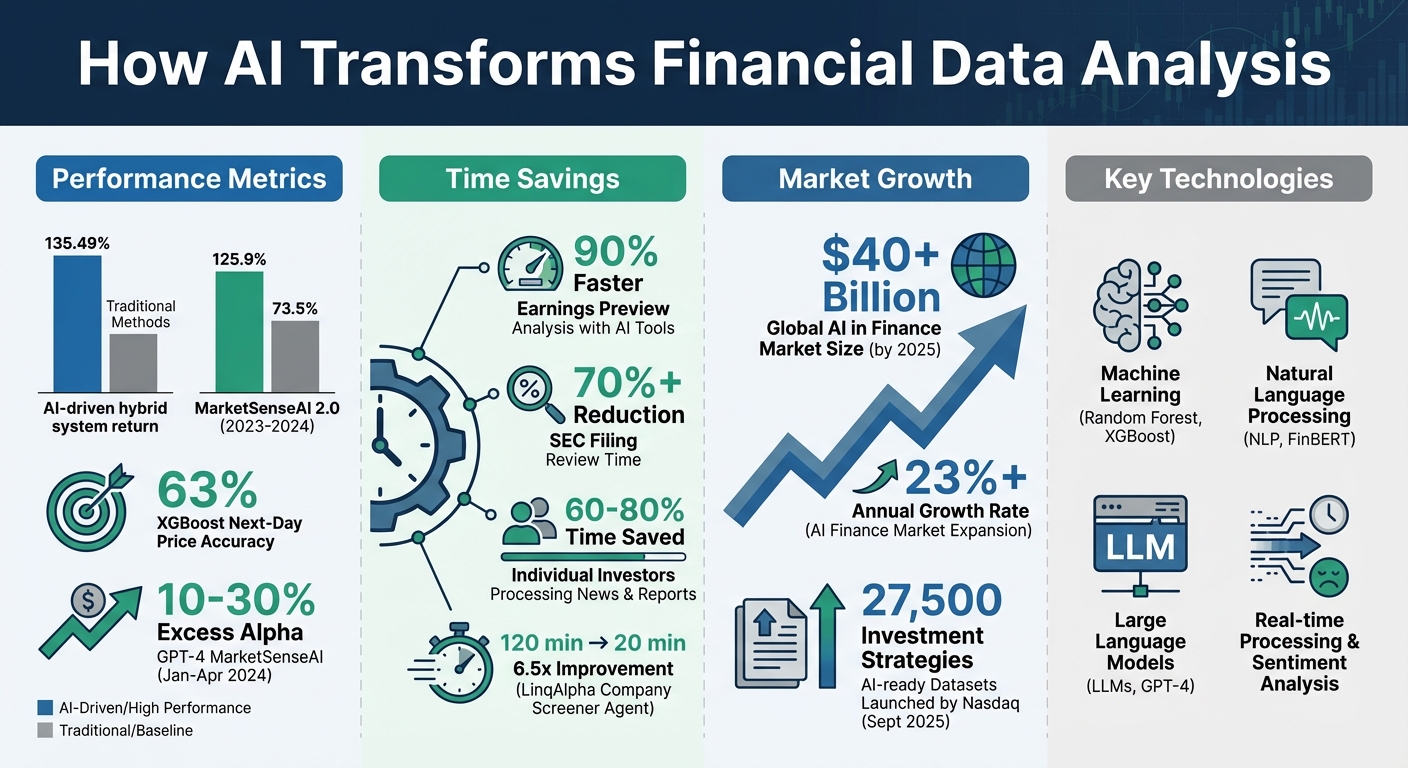
AI Performance in Financial Analysis: Key Statistics and Time Savings
How AI Solves Financial Data Overload
AI Technologies for Financial Data Analysis
AI has revolutionized the way financial professionals handle massive datasets. Take machine learning models like Random Forest and XGBoost, for example. These tools excel at identifying patterns and predicting trends in complex, high-dimensional data - something traditional methods often struggle to do. They sift through hundreds of variables, pinpointing the ones that matter most.
Then there’s Natural Language Processing (NLP), which turns qualitative information - like earnings call transcripts, news articles, and even social media chatter - into actionable, quantitative insights. Finance-specific models such as FinBERT are particularly effective, outperforming general-purpose NLP models when analyzing analyst reports or executive statements. Meanwhile, Large Language Models (LLMs) take it a step further by processing diverse financial data types all at once. Imagine analyzing a 100-page SEC filing, an earnings call transcript, and a stock price chart simultaneously - LLMs make that possible.
What’s especially powerful is how these technologies handle "multimodal datasets." They integrate structured data (like balance sheets or price histories) with unstructured data (such as news sentiment or the tone of a CEO’s remarks). This combination creates a more complete picture for financial analysis, making it easier to filter and interpret data effectively.
Automating Data Filtering and Interpretation
AI doesn’t just collect data - it makes sense of it. For instance, between January 2023 and January 2025, a hybrid system using FinBERT for sentiment analysis suspended trades whenever sentiment scores dipped below –0.70. This strategy helped protect portfolios during downturns. Paired with XGBoost and technical indicators, the system achieved a 135.49% return over two years, turning $100,000 into $235,492.83.
The system also used "regime filters" to detect shifts between bull and bear markets. By analyzing 20-day rolling returns and monitoring volatility, it dynamically adjusted strategies to match market conditions. The XGBoost model alone nailed next-day price predictions with 63% out-of-sample accuracy. These automated filtering tools provide real-time insights that help investors make smarter decisions, faster.
Real-Time Data Processing and Decision Support
AI doesn’t just analyze data; it delivers insights when they’re needed most. Frameworks like Retrieval-Augmented Generation (RAG) ground their analysis in reliable sources, such as SEC filings and earnings call transcripts. Take the MarketSenseAI 2.0 framework, for example. Using a "Chain-of-Agents" approach, it deployed specialized AI modules for news, fundamentals, and economic data to analyze S&P 100 stocks. Over 2023–2024, it achieved a cumulative return of 125.9%, outperforming the index’s 73.5% return. Interestingly, incorporating qualitative data led to adjustments in about 5% of investment signals, such as changing a "buy" recommendation to a "hold".
In September 2025, Nasdaq introduced AI-ready datasets covering 27,500 investment strategies. These datasets, accessible via Snowflake and APIs, allow buy-side firms to automate workflows seamlessly. Daniel Brickhouse, Vice President and Head of Product at Nasdaq Analytics, highlighted the impact:
"Institutional teams are sitting on a wealth of data, but too often it's locked behind manual processes and fragmented systems. With AI-ready datasets and embedded decision support, we're helping asset managers surface the right opportunities faster".
This shift toward real-time, AI-driven decision-making is reshaping how financial data is processed and acted upon, enabling professionals to stay ahead in an ever-changing market.
Calypso's AI Tools for Equity Analysis
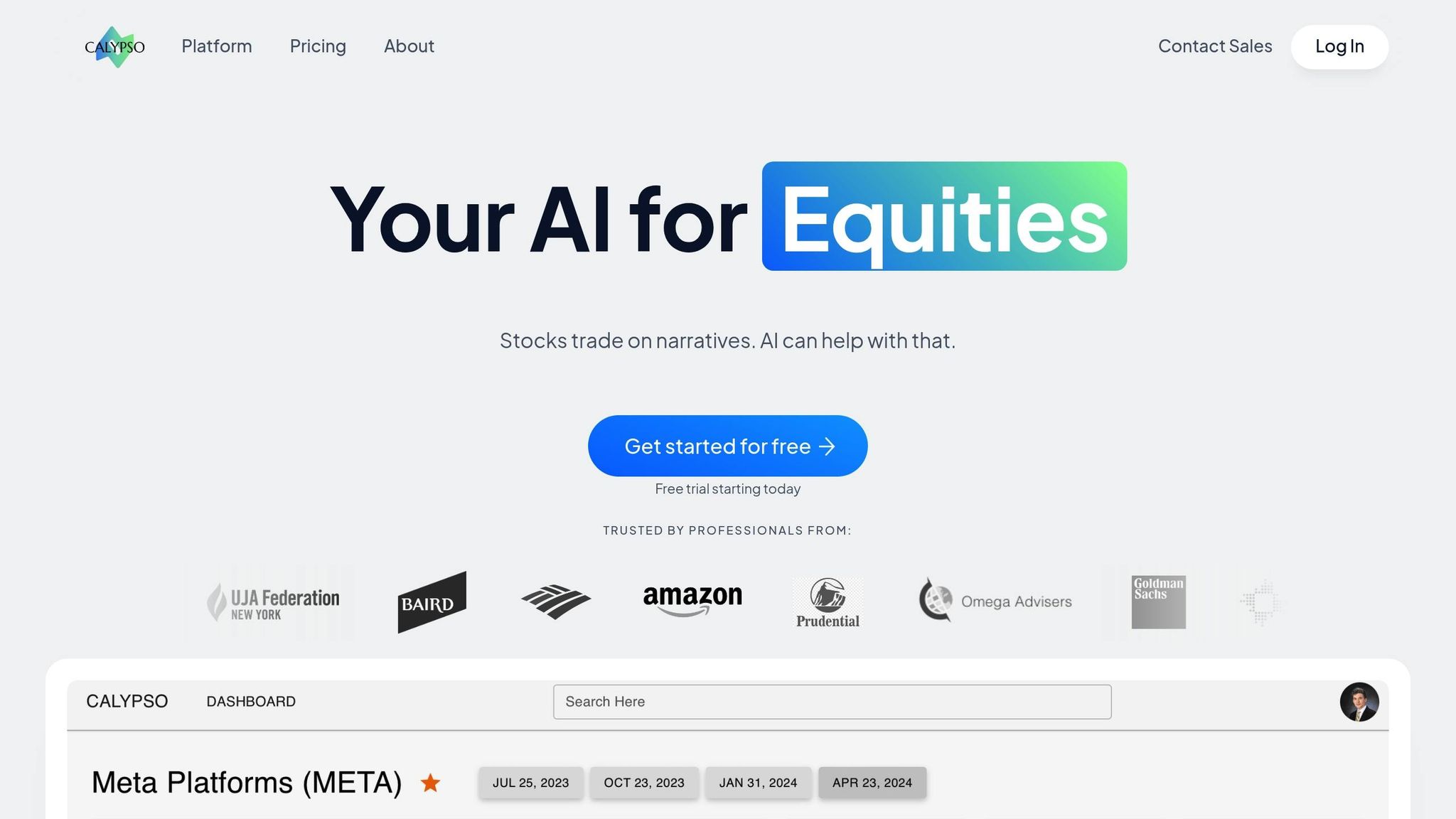
AI Opinions and AI Chats
Calypso's AI Opinions zero in on key stock debates, spotlighting both bullish and bearish perspectives. They also help track your investment theses, ensuring you stay aligned with your original strategy and avoid drifting off course.
Meanwhile, AI Chats, fueled by a finance-specialized GPT-4 model, deliver quick answers to specific questions like, "Did management mention competitors?" or "What’s driving margin expansion?" This tool condenses lengthy 40-minute webcasts into the most relevant insights in seconds. Additionally, Calypso simplifies the process of reviewing transcripts and earnings data for faster decision-making.
Transcript Search and Earnings Previews
Calypso offers even more tools to streamline data analysis:
- Transcript Search: Quickly find specific terms across all public transcripts with direct links to the exact sentences. No more endless scrolling to locate key details.
- Earnings Previews and Updates: These AI-generated summaries of earnings calls compare current results to historical data, helping you identify trends faster. This feature can cut the time needed to get up to speed on new coverage by 90%.
Personalized Dashboards for Portfolio Tracking
Calypso’s personalized dashboards allow you to document your investment rationale and assess how your expectations compare to actual outcomes. This helps refine your decision-making process. As Calypso Copilot puts it:
"Never forget why you bought a stock - or fall victim to thesis creep".
The dashboard consolidates all relevant data in one place - management quotes, key debates, news, financials, and even market rumors - making it easy to monitor both your core investments and broader market trends. Designed to scale for hedge funds, research teams, or individual investors, Calypso offers flexible pricing plans ranging from $10 to $399 per month.
These tools highlight how AI-powered solutions can help cut through the overwhelming flood of financial data, enabling smarter and more efficient equity analysis.
How AI Works in Financial Analysis
Filtering Market Noise
Every day, financial markets generate an overwhelming amount of information. AI steps in to cut through this noise, zeroing in on the data that truly matters. Unlike basic keyword searches, large language models (LLMs) grasp context. For example, they understand that the term "liability" carries different meanings in a balance sheet versus a risk disclosure.
When it comes to earnings calls, AI can pick up on subtle red flags that human analysts might miss. It identifies signs like management hesitation or the use of qualifying language, which could indicate uncertainty or evasion. Techniques like Hypothetical Dense Embeddings (HyDE) allow AI to focus on relevant macroeconomic trends instead of drowning in raw data.
The impact is significant: studies show that individual investors can save 60% to 80% of their time when processing news and earnings reports with AI assistance. Similarly, financial professionals have reported cutting SEC filing review times by over 70%. This ability to filter out unnecessary noise paves the way for deeper, more insightful analysis of financial documents.
Analyzing SEC Filings and News Automatically
AI transforms lengthy regulatory filings into actionable insights, completing tasks in seconds that used to take hours.
Between 2023 and 2024, researchers at Alpha Tensor Technologies introduced MarketSenseAI 2.0, a system that uses a Chain-of-Agents approach to analyze SEC filings and earnings calls for S&P 100 stocks. The results were impressive: the system achieved cumulative returns of 125.9%, far outpacing the index return of 73.5%. According to lead researcher George Fatouros:
"Unlike traditional quantitative models that operate as black boxes, MarketSenseAI supplies detailed explanations for its investment decisions, thereby enhancing transparency and user trust".
Moreover, an analysis of 1,500 summaries showed that incorporating qualitative text from filings helped moderate sentiment scores. For instance, the mean sentiment score adjusted to 0.31 compared to 0.36 when relying solely on numerical data. This demonstrates how risk disclosures in filings can temper overly optimistic financial statements.
This kind of automated analysis not only saves time but also lays the groundwork for more accurate forecasting and smarter portfolio management.
Improving Forecasts and Portfolio Strategies
AI takes forecasting to the next level by blending multiple data streams into adaptive investment strategies. A study conducted by researchers at the Amrita School of Computing tested a hybrid AI system on 100 S&P 500 stocks over two years (January 2023 to January 2025). By combining sentiment analysis with tools like XGBoost, FinBERT, and technical indicators, the system delivered a 135.49% return on a $100,000 investment. It also suspended trades when sentiment dropped below –0.70, achieving 63% accuracy in predicting price direction.
AI is also adept at spotting shifts in market conditions. By monitoring rolling averages and volatility metrics, systems like MarketSenseAI 2.0 can adapt to changing environments. For example, during a 2024 validation test, the system switched between trend-following and mean-reversion strategies, resulting in a 33.8% higher Sortino ratio compared to the broader market.
These advancements show how AI is reshaping financial analysis, making it faster, more precise, and adaptable to ever-changing market dynamics.
sbb-itb-02b1c6d
Benefits of AI for Financial Professionals
Saving Time and Reducing Errors
AI has transformed how financial professionals handle routine tasks, drastically cutting down the time spent on analysis. Take, for example, LinqAlpha, a Boston-based AI startup. In April 2025, they launched their "Company Screener Agent", which quickly became a game-changer for hedge funds and asset managers. This tool reduced the time needed to review news and disclosures from 120 minutes to under 20 minutes per stock - a staggering 6.5x improvement in efficiency.
Beyond saving time, AI significantly reduces errors by automating processes that would overwhelm traditional tools. Natural Language Processing (NLP) plays a key role here, extracting insights from unstructured text like ESG reports, news articles, and earnings transcripts. This automation cuts down on manual reading time, making workflows more efficient. When paired with Python libraries and generative AI, these tools allow professionals to focus on high-level strategy rather than getting bogged down in repetitive tasks. The scalability of these systems ensures that both individual analysts and large institutions can benefit from these advancements.
Scaling for Different User Needs
AI's adaptability shines in its ability to cater to both individual investors and large-scale financial institutions. Calypso's AI tools, for instance, provide broad and efficient coverage across a wide range of stocks. These systems synthesize vast amounts of data, including earnings calls, analyst reports, and news from hundreds of companies - far beyond what traditional methods could handle.
One standout feature is the use of "Audit Agents", which verify AI-generated conclusions by cross-referencing them with original source documents. This ensures accuracy and prevents the spread of misinformation, maintaining high-quality analysis even at scale. Calypso's approach demonstrates how AI can meet the diverse needs of investors, from individuals to major institutions, without compromising on quality.
Gaining a Competitive Edge
In today’s fast-paced financial markets, AI provides a clear advantage. A study conducted between January 2024 and April 2024 by Georgios Fatouros, Konstantinos Metaxas, John Soldatos, and Dimosthenis Kyriazis showcased the effectiveness of the MarketSenseAI framework. Using GPT-4, they analyzed S&P 100 stocks over 15 months, integrating market trends, news, and fundamentals to generate investment signals. The result? An excess alpha of 10% to 30% and a cumulative return of 72%. As the researchers stated:
"Our findings highlight the transformative potential of Large Language Models in financial decision-making, marking a significant leap in integrating generative AI into financial analytics."
This level of performance underscores the competitive edge that advanced AI can deliver. It’s no surprise that over two-thirds of investment professionals surveyed in 2024 expressed interest in developing AI skills to stay relevant in their roles. Cheryll‑Ann Wilson, PhD, CFA, from the CFA Institute, emphasized the growing synergy between traditional tools and new technologies:
"The integration of advanced tools such as generative AI and Python libraries is creating synergies between traditional and emerging technologies, offering new avenues for innovation."
The financial sector is now riding the "third wave" of technological innovation, with AI powering faster transactions and smarter decision-making. Those who embrace these tools are setting themselves up for success in an industry that’s evolving at breakneck speed.
Analyze Financial Data with AI! Build a Local Agentic RAG to Analyze Stocks (LangGraph & Ollama)
Conclusion: AI Solves Financial Data Overload
AI is changing the way financial professionals handle massive amounts of data. By bringing together key financial documents into a single, streamlined view, AI eliminates the need for hours of manual analysis. Tools like Calypso's AI Opinions and Transcript Search are designed to help investors sift through market noise, follow investment narratives, and find specific insights in thousands of documents - within seconds.
The benefits are hard to ignore. Calypso's AI tools have been shown to speed up analysis by 90% compared to manual methods. For example, in December 2025, Swedbank joined forces with Nasdaq Calypso to use AI for pulling trade and settlement data, automating their treasury operations from start to finish. As Nasdaq highlighted:
"AI is helping financial institutions with faster decision-making, smarter risk management, and real-time automation".
Rather than replacing human expertise, AI complements it. With features like sentiment-aware forecasting and real-time risk adjustments, these tools strengthen traditional financial models while ensuring transparency for regulators and investors. Researchers from npj Artificial Intelligence put it best:
"By augmenting rather than replacing financial theory, this approach not only improves empirical performance but also enriches theoretical understanding".
The potential for growth is staggering. The global market for AI in finance is expected to exceed $40 billion by 2025, with an annual growth rate of over 23%. Calypso's AI solutions are a prime example of how this technology offers a competitive advantage. By integrating AI into your workflow, you gain the speed, precision, and confidence to stay ahead. The real question is: how quickly can you adapt?
FAQs
How does AI help improve investment returns compared to traditional methods?
AI is transforming investment strategies by handling massive and complex datasets far more efficiently than traditional approaches. With the help of machine learning and natural language processing, AI can sift through structured data like financial metrics and unstructured data such as earnings reports or market news. This allows it to spot opportunities and risks that manual analysis might miss.
Additionally, AI strengthens decision-making by integrating a variety of data sources, including historical trends, real-time market signals, and alternative data like credit card transactions or shipping patterns. This broad perspective enables quicker, more accurate decisions, helping investors stay agile in fluctuating markets and uncover profitable opportunities. By simplifying analysis and delivering deeper insights, AI equips investors with the tools to make better-informed choices and potentially boost returns.
How do Large Language Models (LLMs) enhance financial data analysis?
Large Language Models (LLMs) are changing the way financial data is analyzed by sifting through massive amounts of both structured and unstructured information. Think news articles, earnings reports, or even shifting market trends - LLMs process it all to uncover patterns and insights. This helps investors cut through the market noise, zeroing in on actionable details for faster, smarter decisions.
When it comes to tasks like stock price forecasting, sentiment analysis, or risk assessment, LLMs shine by pulling together complex datasets and delivering precise predictions. They also enable real-time analysis, making them a powerful tool for automated trading strategies. In short, LLMs streamline financial decision-making, making it both quicker and more accurate.
How does Calypso use AI to improve equity analysis and investment decisions?
Calypso uses AI technologies like machine learning, natural language processing (NLP), and predictive analytics to make equity analysis simpler and more effective. By automating the review of massive datasets - think financial reports, market trends, and even news - Calypso allows investors and analysts to uncover actionable insights more quickly and with improved precision.
Its AI-driven tools cut through market noise, condense complex data, and make sense of unstructured information. This not only saves time but also reduces the need for manual analysis. On top of that, Calypso offers real-time tracking of market sentiment and news, helping users identify risks and opportunities more quickly. These features give investors the ability to make better-informed decisions, adjust strategies with confidence, and manage portfolios more efficiently.
